
BASEL KOMPONIERT – Elisa Urrestarazu & Cornelia Lenzin
Elisa Urrestarazu – Saxophone | Cornelia Lenzin – Piano
Free E-Booklet as PDF:
Digital Booklet Basel komponiert PV115
Buy the digital album in the PIANOVERSAL SHOP: PIANOVERSAL SHOP
© PIANOVERSAL
With "Basel Komponiert," the duo Urrestarazu – Lenzin presents a multifaceted album featuring contemporary music from Basel.
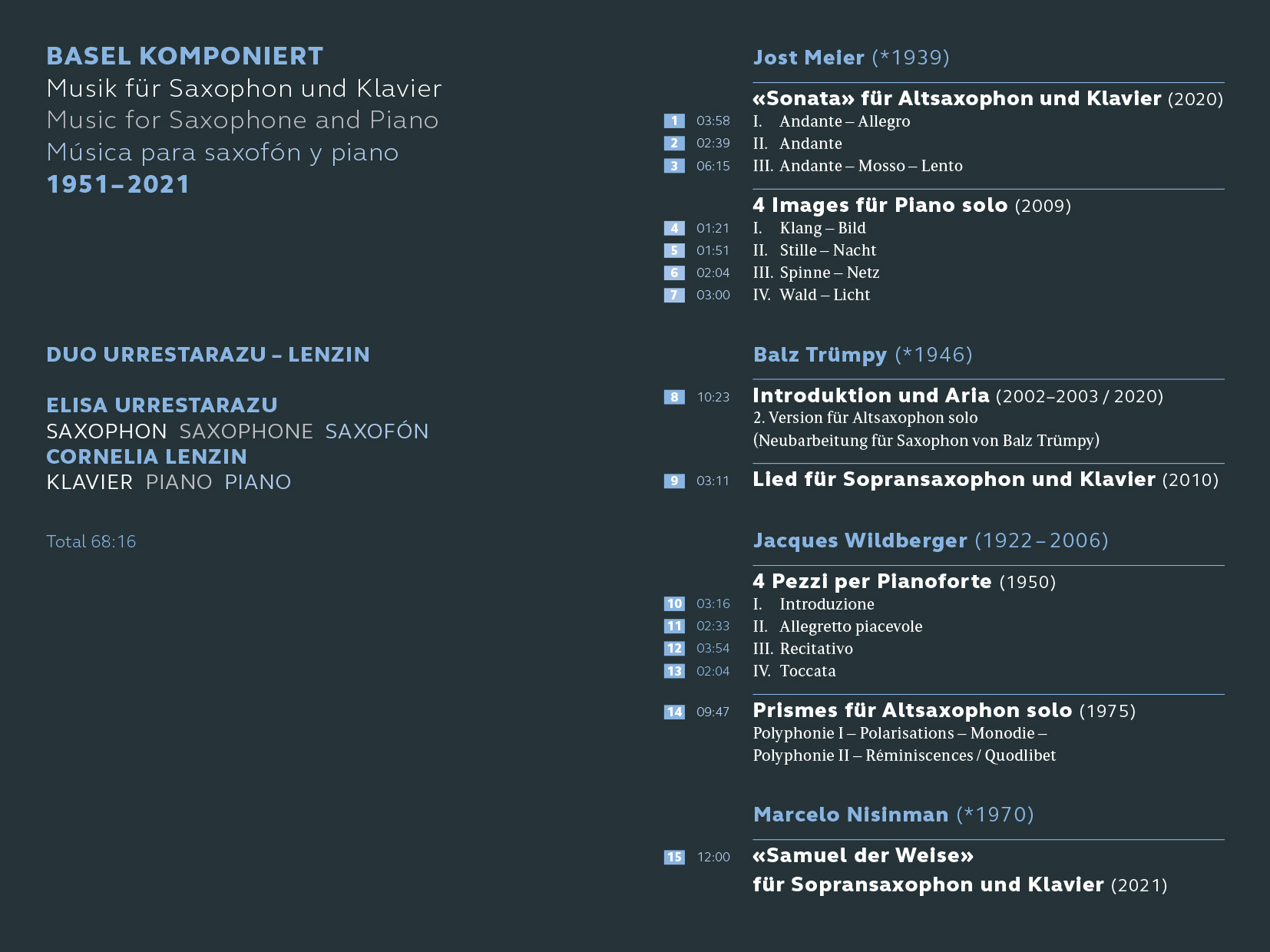
Both the "Sonata" for saxophone and piano by Jost Meier and the composition "Samuel the Wise" by Marcelo Nisinman were written for the Urrestarazu-Lenzin duo and premiered in Basel on September 1, 2021.
"Introduction and Aria" for solo saxophone – originally composed for clarinet – was newly arranged by Balz Trümpy for Elisa Urrestarazu. This work is recorded here for the first time. The same applies to the "4 Images" for piano by Jost Meier.
The program is supplemented by the "4 Pezzi" for piano and "Prismes" for saxophone by Jacques Wildberger, who would have celebrated his 100th birthday in 2022.
Jost Meier: "4 Images" for Solo Piano (2009)
With four word pairs, a hyphen indicates a relationship (contrast, refinement, consequence, etc.).
I. Sound – Image: Linear and punctual moments are juxtaposed with an expanded sound.
II. Silence – Night: Resonating soft overtones are perceived as silence. The night (Christmas) is based on a quotation from the song "Silent Night."
III. Through the spider's activity (Part 1), the net is created (Part 2). Thin threads can only be distinguished from one another through very small changes.
IV. Forest – Light: In the forest, light filters through the branches of trees only occasionally. Upon entering the meadow, only light remains (the note "a"). (Jost Meier)
Balz Trümpy: "Introduction and Aria" (2002/2003 – 2020)
2nd Version for Solo Alto Saxophone (2020)
Introduction and Aria consists of two parts connected attacca and related thematically. The melody played fortissimo in an extreme register, which appears in the middle of the Introduction, forms the starting point of the Aria in pianissimo, whose development in turn leads back to the beginning of the Introduction. The piece explores the spectrum of technical possibilities of the alto saxophone without employing special playing techniques. The 2nd version of Introduction and Aria is dedicated to saxophonist Elisa Urrestarazu. (Balz Trümpy)
Balz Trümpy: "Song" for Soprano Saxophone and Piano (2010/2011) "Song" is the fifth piece from my cycle To Florestan and Eusebius (2010/2011). This work for saxophone, trombone, and piano was written as a homage to Schumann, whose intricate counterpoint has strongly influenced my composing. Song builds in the dialogue between soprano saxophone and piano to a climax followed by a calming resolution. (Balz Trümpy)
Jacques Wildberger: "4 Pezzi per Pianoforte" (1950) and "Prismes" (1975)
Engagement and Display
"I must have an engagement!" Jacques Wildberger is known as a composer of music that is involved and politically committed. What is often overlooked is that he also wrote a long series of extremely valuable instrumental solo pieces that are not actually politically motivated. Rather, these mostly virtuosic works are meant to give performers the opportunity to "display their feathers."
Wildberger, who completed his studies as a pianist in Basel in 1944, wrote the "Quattro Pezzi" (1950) for his own instrument. This is essentially his Opus 1. In the conservative Swiss musical life of the time, this was a political statement when Wildberger entered into aesthetic opposition against the prevailing bland neoclassicism.
In many works, musical language must literally be reassembled from fragments and shards. This is also clearly evident at the beginning of "Prismes," which he composed in 1975 for a colleague at the Basel Conservatory, saxophone professor Iwan Roth. (Michael Kunkel)
Marcelo Nisinman: "Samuel the Wise" for Soprano Saxophone and Piano (2021) The piece "Samuel the Wise" is inspired by the life and work of Samuel Nisinman, son of Russian immigrants who came to Buenos Aires at the beginning of the 20th century. One could say that the form of the work is classical, but its language is in many moments atonal, dissonant, and breaks with the "typical" harmonic progressions of traditional tango music. (Marcelo Nisinman)
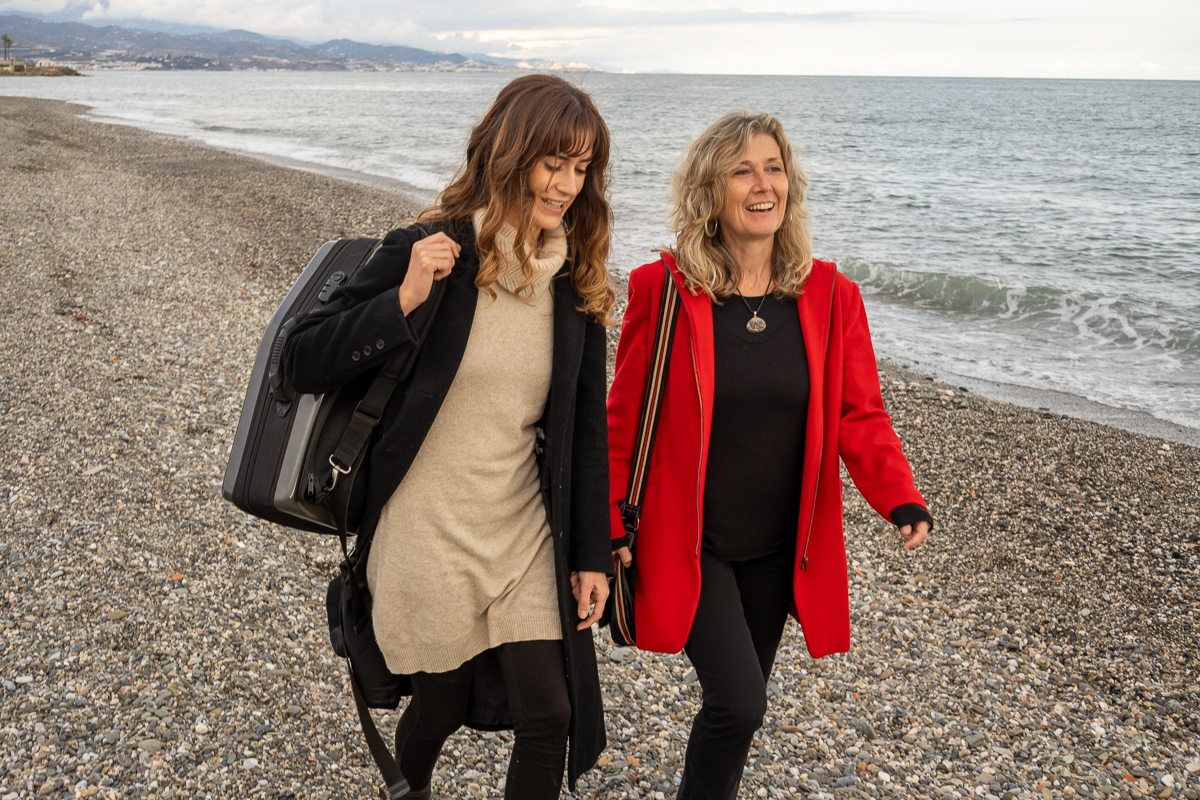
Elisa Urrestarazu & Cornelia Lenzin © PIANOVERSAL